
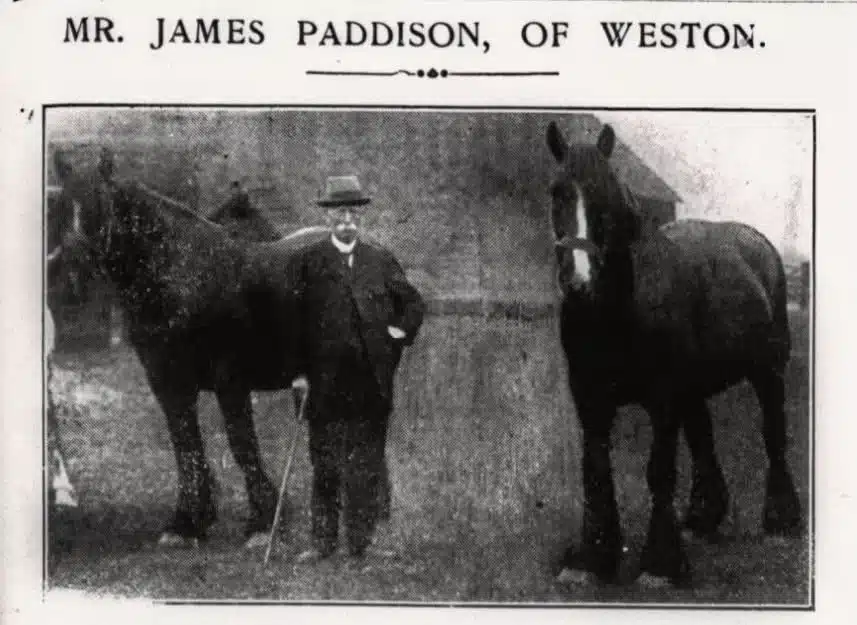
The life of a Mr James Paddison of The Elms, Weston.
This was from the Lincolnshire Free Press, June 1921.
The document was painstakingly copied the text of the story, so I hope you all enjoy the read.-
Striking incidents in a remarkable career.
A fine type of agriculturist is Mr James Paddison of the Elms, Weston.
And a fine figure of man, massive in frame, upright in figure, despite the weight of over 70 years. Serene countenance, blond and keen eyed, one can imagine him 1,300 years ago as a Viking chief, standing at the prow of his vessel, ready to leap ashore and lead his men to victory.
In the course of an interesting conversation last week with this old standard, who has recently been seriously ill, but is now, we are glad to say, much better, we learned that James Paddison was born at Surfleet in 1849, his father being a poor man who was brought up in the workhouse, and used to work at is. 10d. a day.
James went on to work at eleven years old for Mr Robert Mawby, father of Mr T. O. Mawby, on his farm in Spalding Marsh at 4d. a day. Then in 1862 he went to service with Mr Tom Boothby, at Gosberton Belnie, his wages being £2 10s, for his first year, and his food. Next year he lived with Mr Hammond, of Boston West, at £6 a year. This was in 1863, the year King Edward was married.
“We used to reckon to get up at five o’clock in the morning, and work till eight at night,” remarked Mr Paddison. Then he went to Mr John Rowland, Eastville, father of Mr Ben Rowland.
The next move was to Gosberton, where he went as groom to Dr Calthrop. From there, G. Calthrop, the well known solicitor, brought him to Spalding and secured him a situation with Mr Robert Everard at Fulney as “pad groom”.
“Then”, continued Mr Paddison, I went to be coachman for the late Mr Ashley Maples in High Street. From there, in 1868 I took the White Hart yard in Bingham and Townsend’s time. That was when the elections were open with free nights and free beer. “At the time they used to brew at the White Hart three times a week and to serve all the principal farmers with beer. I had the management of the whole yard and also of a farm at Pinchbeck Marsh, and some grass at Wykenam.”
Mr Paddison’s first home in Spalding was in Malting House Square, he having married Miss Rachel Kirby, of Oundle. “After I had been married a year I took the White Hart Tap, and was there eleven or twelve years. During my time at the White Hart there were three landlords, Bingham and Townsend, George North, and Samuel Harper.” With tears in his eyes, the old gentleman added, “When I left Mr Harper neither of us could speak.”
“The next thing was Mr J. G. Calthrop, my best friend, who always took a great interest in me, got me to take the Peacock Inn in Pinchbeck Street. After I had been there eleven or twelve years he got me to take a farm at Weston Hills which Mr Wm. Gedney used to occupy.”
Mr Paddison’s first wife died at the Peacock and he married the widow of the former landlord, Mr Mord Manton, who went to the Chequers at Weston and died there. Mr Paddison carried on both houses for a time, and then went to the Chequers so that his wife had the unusual experience of having lived in two licenced houses twice over.
After some time, Mr Paddison bought the Elms, Weston, where Mr John Goodale used to live, and in 1912 bought a farm at Weston Hills, and at the present time is the owner of property in four parishes- Moulton, Weston, Spalding and Gosberton. No small achievement for a poor Surfleet lad.
“The first year I was in service – 1862,” said Mr Paddison “there were beans out Christmas day. It was a very wet time. Corn had grown as long as your finger before it was cut. We used to bake our own bread, it dropped away from the crust and in the middle was just like a bit of putty. That is how we lived. There was a large family of us. We saw a little bit of meat on a Sunday. We kept a cow and ‘tented’ it on the road. Bread and milk was our principle living. We used to have a stick oven and cook the dinner on Sunday and bake the weeks bread.
“I have seen every farm change hands since I came to Spalding in 1866,” continued the veteran. That was cattle plague (rinderpest) year. They were shooting beast all one Sunday down at Mr Wyche’s at Postland and burying them. They had a meeting at squire Everard’s on the Sunday to know what to do. Everybody was bewildered, hundreds of beast in the district were slaughtered.”
“I have sold wheat at 17s 6d a quarter and oats at 13s. We used to feed beef at 6s to 6s 6d a stone. We have since made as high as 23s.”
But it is pre-eminently as a lover of stock that Mr Paddison has made his mark. He is known far and wide as one of the finest judges of a horse in the country. Some years ago he sold a shire horse to King Edward at £120 to send out to Canada as a specimen of the Lincs breed which was thought a wonderful price in those days.
His most remarkable deal however, was a year or two ago, when he sold five horses (geldings) off his farm out of work for £1030. He has bought for the big firms and corporations all over the country including the Birmingham and Liverpool corporations, large brewery firms, and the principal buyers in London and the provinces.
“I have done business with almost every farmer and know every lane and road within 20 miles of Spalding.” added Mr Paddison. “I used to attend five markets every week and six once a fortnight : Sleaford on Monday, Spalding Tuesday, Boston Wednesday, Borough (every fortnight) Thursday, Long Sutton Friday and Peterborough Saturday, beside farming my bit of land , attending fairs, shows etc.”
As an exhibitor of horses and cattle, Mr Paddison has won many prizes including the Birch Cup at Holbeach for four best beast, and has acted as judge at nearly every agricultural show in Lincs, and in a good many other counties, and at fat stock shows at Long Sutton, Holbeach, Crowland, Boston, Frithville and elsewhere. He has also been called into the ring many times to act as umpire. And he is still in business.
All honour to a grand old man whom everyone respects and whose friends are legion. May he live for many years to enjoy the fruits of his labours.
We use cookies to improve your experience on our site. By using our site, you consent to cookies.
Manage your cookie preferences below:
Essential cookies enable basic functions and are necessary for the proper function of the website.
These cookies are needed for adding comments on this website.
Statistics cookies collect information anonymously. This information helps us understand how visitors use our website.
Google Analytics is a powerful tool that tracks and analyzes website traffic for informed marketing decisions.
Service URL: policies.google.com (opens in a new window)