
For most of history, the area covered by Little Sutton parish lay in a shallow sea, but by Anglo Saxon times the sea had receded somewhat and the area found itself in an intertidal zone, and so the landscape was inhospitable and uninhabitable saltmarsh and mudflats. To its west and south, deposits of clay and silt created slightly higher ground and in medieval times settlements began to appear on this highly fertile ridge of silt. The ‘Townlands’ were born, including a settlement at Long Sutton. It is difficult to precisely pinpoint when Long Sutton became settled but there is general agreement that it was in the middle to late Anglo Saxon period (AD650 to AD1000). At some time during this period a defensive sea bank was built along the then coastline of The Wash (this sea bank was originally considered to be older, of Roman origin – AD43 to AD410 – but historians’ opinion is that this is not the case). The sea bank would have protected the settlements from inundation by the sea, and thus making agricultural activity much less risky.
The area covered today by Little Sutton Parish was on the seaward side of the sea bank, and so remained saltmarsh and mudflats (part of what became termed as Sutton Marsh). The only potential human activity in the area would be fishing or wildfowling, though the ground would have been potentially treacherous. An industry that was booming in these parts in Anglo Saxon times was salt making on the salt marshes, but there is no evidence of any such activity in the Little Sutton area.
Things stayed this way for hundreds of years, until in the mid-1600s a major land reclamation scheme in The Wash area was undertaken. A new sea bank was built along much of the southern section of The Wash, holding the sea back a few miles further north and east. Thousands of acres of land were thus reclaimed from the sea, including the area covered by present day Little Sutton Parish.
It is not known when any permanent settlements started to appear in the Parish, but there has never been any attempt at substantial settlement. Since the land was reclaimed from the sea, it formed a part of what became common land for grazing sheep and cattle. Guys Hospital in London bought much of the land in and around Sutton Marsh as part of its extensive land holdings across a number of English counties. The name of one of the roads in the Parish, Hospital Drove, is probably a reference to Guys Hospital.
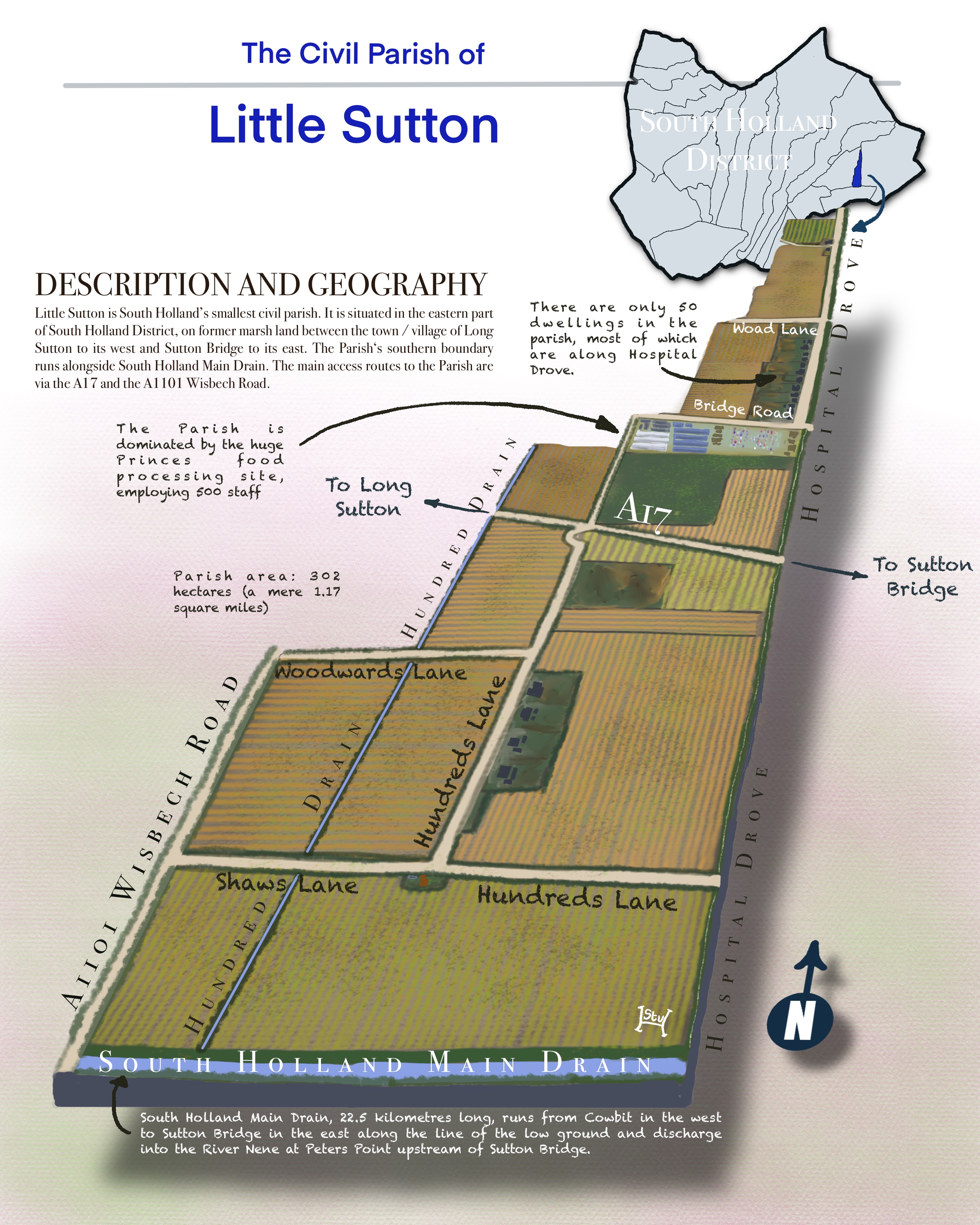
Even today, settlement is very limited, with only 50 dwellings standing. The Parish can best be described as being an outlying area on the fringe of Long Sutton. Indeed, from an ecclesiastical point of view, the area was, and still is, part of the Parish of Long Sutton St. Mary.
(Author: Stuart Henderson, 2020)
We use cookies to improve your experience on our site. By using our site, you consent to cookies.
Manage your cookie preferences below:
Essential cookies enable basic functions and are necessary for the proper function of the website.
These cookies are needed for adding comments on this website.
Statistics cookies collect information anonymously. This information helps us understand how visitors use our website.
Google Analytics is a powerful tool that tracks and analyzes website traffic for informed marketing decisions.
Service URL: policies.google.com (opens in a new window)